

In an environment where technical projects span years, where failure is part of the game and the best experts are highly sought after, motivation is not an HR topic: it's the primary performance lever.
Here are the concrete answers I've seen work with my clients (industry, medtech, energy, aerospace) and that I now share on motivationrd.com.
Why is motivating an R&D team a critical performance issue?
Because when an R&D expert is demotivated, they don't work at 80% capacity: they work at 20%. The rest of the time they put on a brave face, follow processes, but no longer take any risky initiative... and that's precisely where innovation is born.
An internal study at a client (CAC40 group) showed that a 15% increase in intrinsic motivation reduced development timelines by 9 months on average for 3-5 year projects.
Game changer.
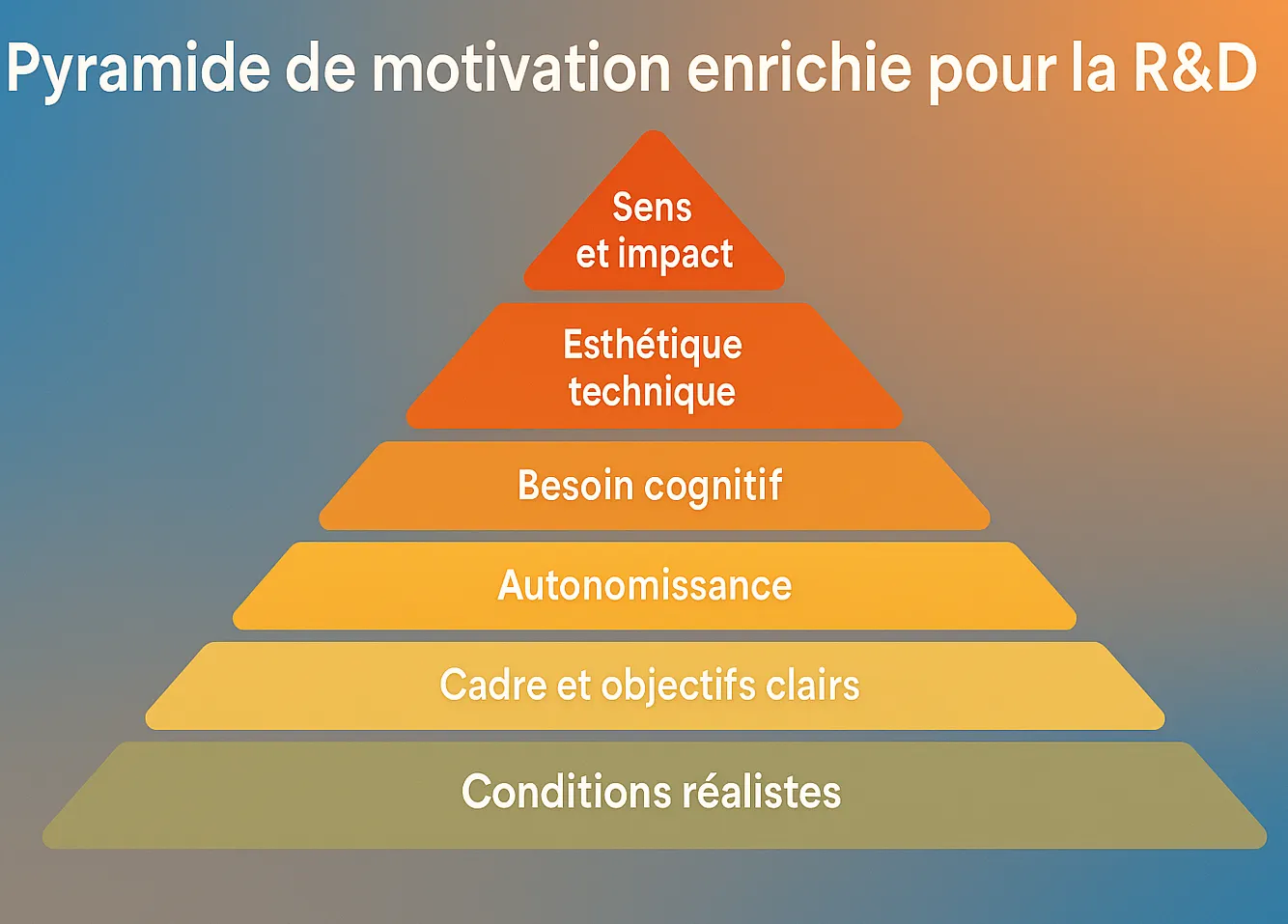
What are the specific needs of R&D experts according to the enriched motivation pyramid?
The classic Maslow hierarchy is no longer sufficient. In R&D, the real needs of experts are, from bottom to top:
- Realistic conditions (deadlines, resources, workload)
- Clear framework and objectives
- Recognition of expertise and contributions (even invisible ones)
- Technical autonomy (choosing your "how")
- Cognitive need (understanding complex things)
- Technical aesthetics (doing things "properly", elegantly)
- Meaning and final impact of the project
If one of the lower levels is breached, the upper levels become inaccessible, unless management provides informed support.

How to bring clarity and stability to R&D objectives?
The vast majority of demotivation cases I see start with a vague objective or one that changes every 6 months without explanation.
Golden rule: you can change the objective, but never without explaining the "why" and without realigning everyone.
Practice that works: every quarter, a meeting where the CTO / R&D director personally explains the roadmap, the absolute priorities (max 3) and above all why certain topics are kept or deprioritized.
Observed result: energy levels aligned with what matters.
How to grant real technical autonomy to experts?
Stop saying "I trust you" while reviewing every line of code or every diagram. Real autonomy means:
- I tell you the WHAT and the WHY
- You choose the HOW
- I challenge you on the result, not the method
At a medtech client, we went from 3 levels of validation to just 1 for technical choices. Result: 40% more spontaneous initiatives in 6 months and an 18% reduction in time-to-market.

How to develop active listening and sincere recognition in R&D?
Experts hate "great job team" and generic praise. They want you to recognize precisely what they did and why it was difficult.
Example of a magic phrase: "I saw that you managed to increase yield from 87 to 93% on the new converter despite extreme thermal constraints. Few teams would have pulled that off. Thank you."
Guaranteed effect.
For skeptics who believe a sincere thank you will immediately be followed by a request (e.g. a raise), you're wrong... BUT I'd struggle to convince you in just a few lines ;)
In practice, what I systematically observe: the person gets back to work with visible renewed energy, often proposes an additional idea in the following days, and the overall team atmosphere improves durably. Precise recognition is a management act that pays off enormously.
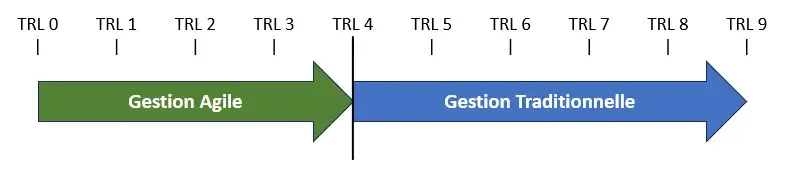

Why adopt hybrid hardware agility for exploratory R&D phases?
Pure agility from IT scares management and kills creativity in early R&D phases (jargon, inappropriate post-its...). The solution that works everywhere: hybrid hardware agility as developed by SolidCreativity.
Check if it's been validated in your field: our client references.

How to detect and counter motivation blockers in R&D?
The 3 early warning signals I systematically track:
- Fewer spontaneous proposals in meetings
- Wait-and-see attitude ("we're waiting for validation from...")
- Nobody defends their technical point of view anymore
When I see 2 out of 3: red alert. Immediate intervention on the 2-3 most damaged levers (usually clarity + autonomy).
How to take action for a more engaged and innovative R&D?
You now have the levers that really work in the field. If you want to implement them quickly and without mistakes:
Discover the Motivate Your R&D Teams training (2 days on-site or in-house) and the Agile Methods for Physical R&D training.
R&D motivation is often the poor relation of innovation policies, yet it's the primary driver of technological sovereignty.
Your R&D deserves better than silent demotivation. Take action.
