
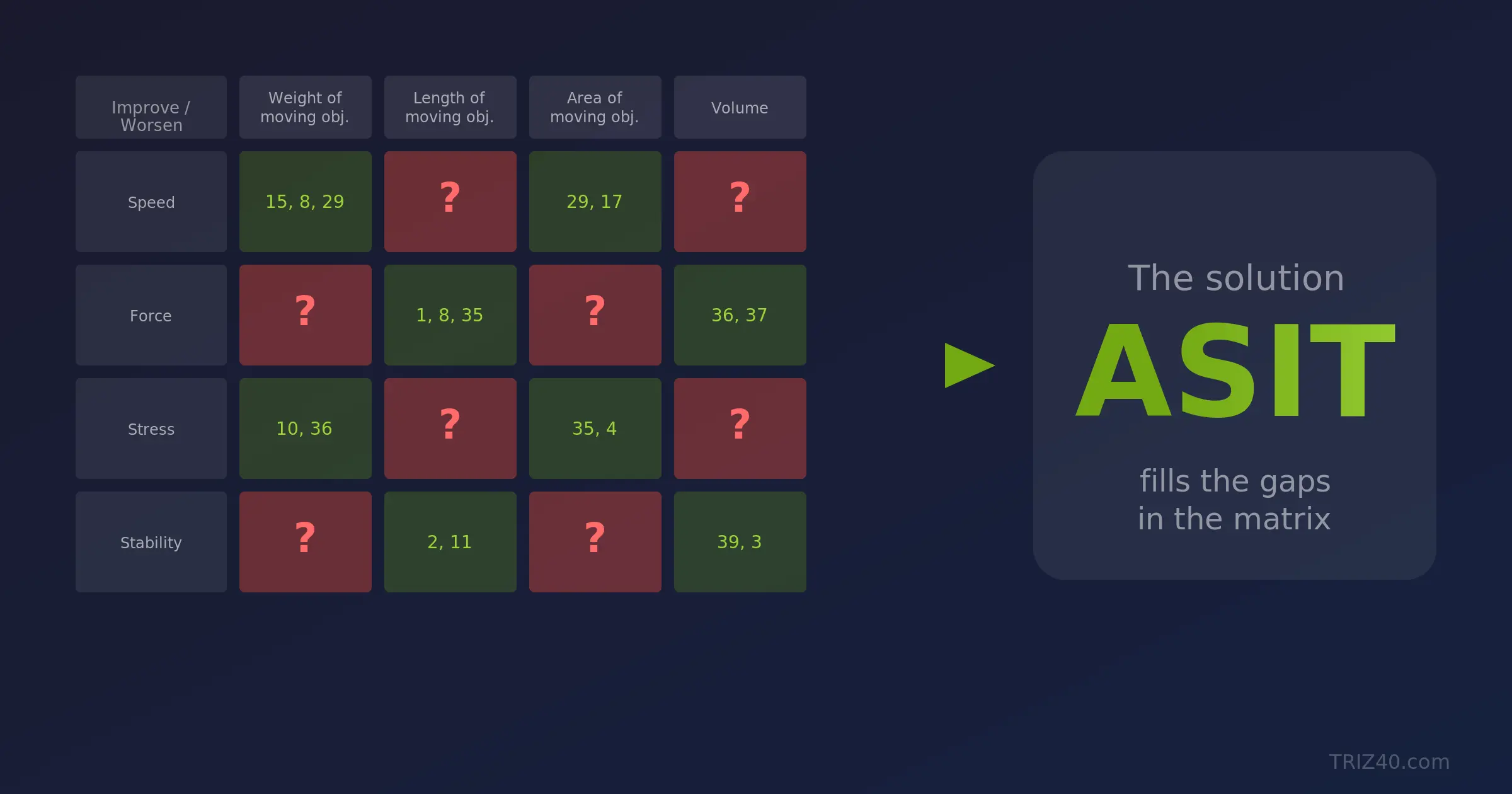
The TRIZ contradiction matrix is a remarkable tool. Thousands of engineers use it every day to turn a technical problem into concrete solution leads. Samsung, Airbus, Boeing, Shell... the list of companies that have integrated it into their R&D process is long.
But let's be honest: if you've ever worked with the matrix on a real-world problem, you've probably run into one or more of these frustrating moments. And you're not alone, the scientific literature documents them too.
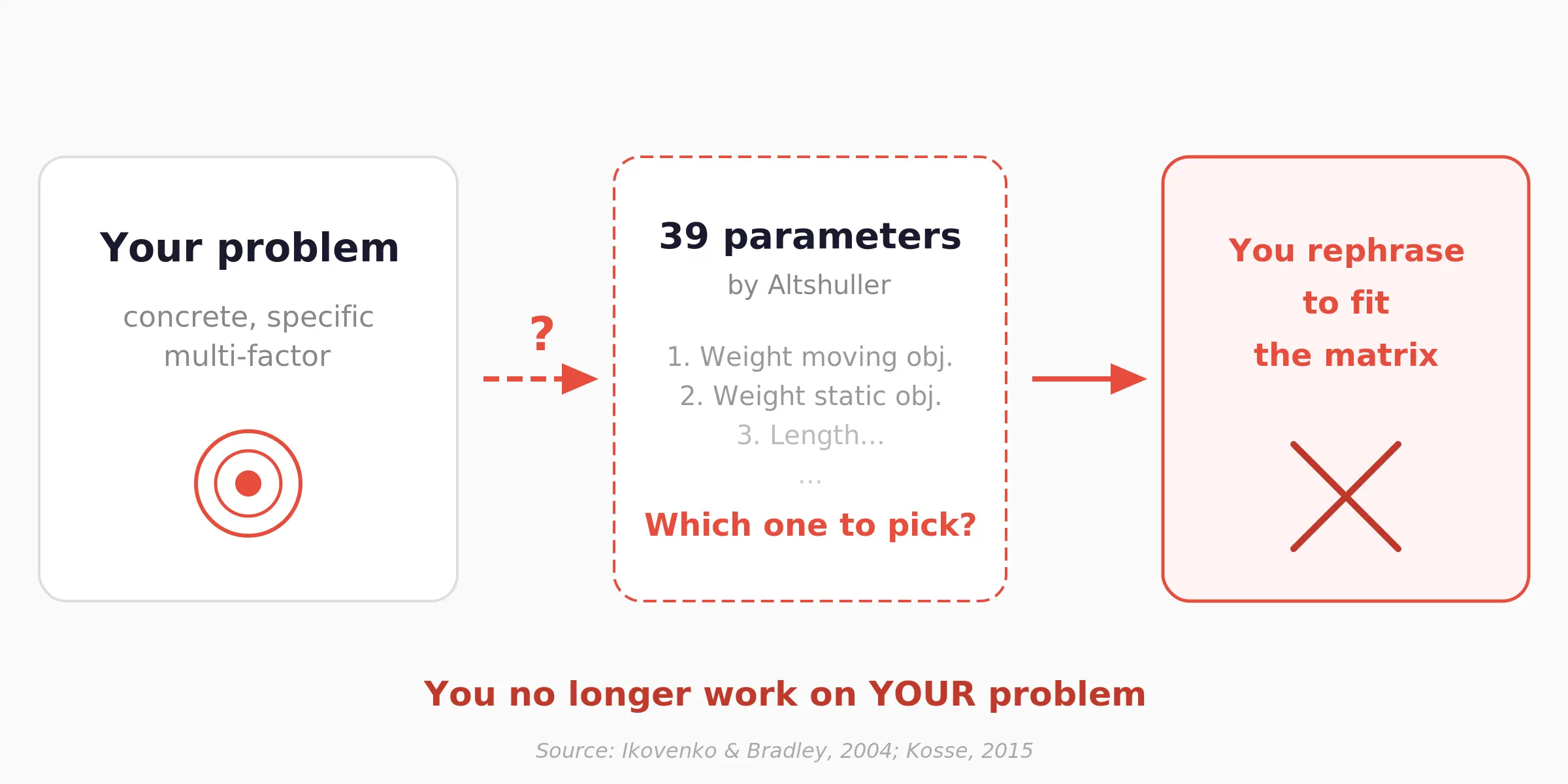
Problem #1: Choosing the contradiction, a tricky exercise
The principle behind the matrix is elegant: you identify the parameter you want to improve, the one that degrades as a consequence, and the matrix suggests Inventive Principles. Simple on paper.
In practice? Mapping your actual problem to Altshuller's 39 parameters can be quite a challenge. As Ikovenko and Bradley (2004) point out, the formulation of system conflicts is often unstructured, and the matrix itself offers no guidance for this critical step. You try one parameter, then another. The risk: never working on the right contradiction.
Problem #2: 3 or more criteria? The matrix expects 2.
The matrix works in pairs: one parameter improves, one degrades. Two. Not three, not four.
Yet in industrial reality, problems are rarely that binary. You want to improve mechanical strength, but it impacts weight, cost and ease of manufacture all at once. Three degraded parameters for one improved. What do you do? Pick the "worst"? Run the matrix three times hoping to find a common Principle? Research confirms this limitation: handling multiple simultaneous contradictions remains an open problem in the TRIZ community.
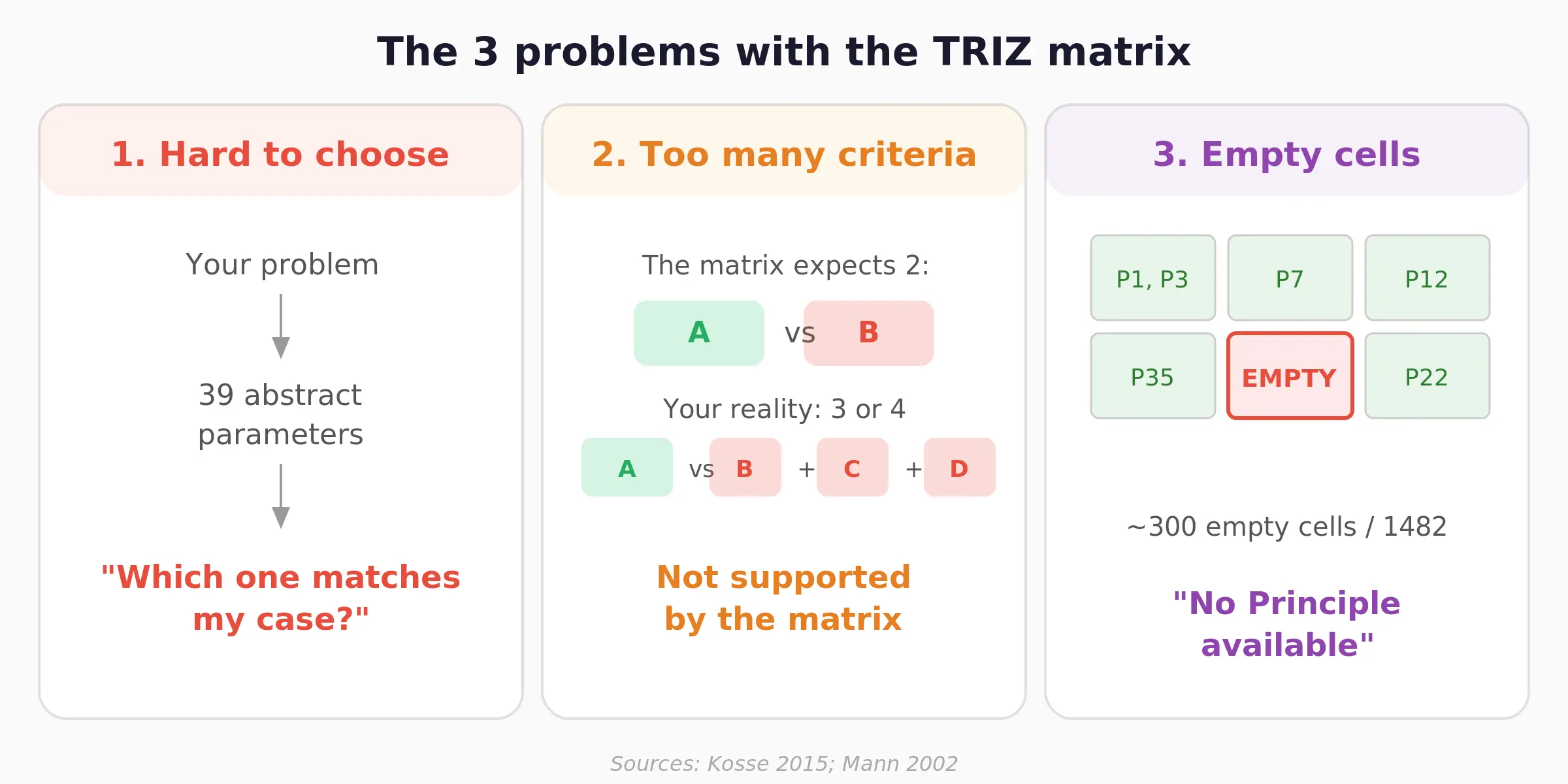
Problem #3: Empty cells, when the matrix says "figure it out"
And here's the most frustrating one. After struggling to formulate your contradiction, picking your two parameters... the matrix displays an empty cell. No Principle suggested. The matrix contains 273 empty cells out of 1,482, i.e. 18%. Sounds OK, but if your problem falls right into one, that's 100% frustration.
As researchers note, these empty cells mean that no Inventive Principle was identified as statistically more frequent than others for that combination. In plain terms: the matrix has no opinion. And you're back to square one, rephrasing your contradiction differently, sometimes "biasing" it, just to get an answer. Any answer.
The perverse outcome? You end up no longer working on your real problem, but on whatever the matrix and your TRIZ proficiency level have decided for you.
Avenues for improvement? Yes, but...
These three problems are not new, and various efforts have been made to address them. With mixed results.
For the difficulty in finding the right parameters, some now use AI chatbots to help formulate their contradiction. The risk is real: many make the mistake of skipping the TRIZ matrix entirely and going straight to the AI's proposed solutions, with 0% creativity. Because it is precisely the human genius that makes the difference in TRIZ: it is the engineer, with their talent and background, who transfers a generic Principle into their own domain to create an original solution. Remove the human from that loop, and you remove the creativity.
For multiple inputs, some interesting and promising research is heading in this direction. However, we are not aware of any available tool that concretely simplifies the use of the matrix through this approach.
For empty cells, newer versions of the matrix exist, with more parameters, more Principles, and fewer gaps. Domain-specific versions have also been proposed, and we encourage you to check whether research in your field is available. However, it is likely that these "inflated" matrices (such as the 2010 version), which aim for greater precision, suffer from undesirable side effects: more parameters make the choice even harder. More Principles, fine, but they become less general - the very concept of "Principle" tends to fade when you keep adding them. And the intended precision may only be perceptible to experts. This is why we did not integrate these inflated versions on TRIZ40.
What we did on TRIZ40
On TRIZ40.com, we have been offering for several years a free interactive matrix with illustrated examples for each Principle. The goal has always been to make TRIZ more accessible, more concrete, less abstract.
And first, we simplified the entry into the matrix. On TRIZ40, we don't talk about "contradiction". The interface simply asks what you want to improve, and what you don't want to degrade. Then it rephrases your choice in plain language, so you can verify that you're actually working on your problem and not on an abstraction.
But the fundamental problems of the matrix persisted. Or rather... they used to.
Because in our latest update, we added over 1,500 concrete examples alongside the existing TRIZ Principles: one example for each of the 40 Principles, and one example for each of the 1,482 off-diagonal cells in the matrix. And these examples don't come from nowhere: they come from the ASIT method.
ASIT: not a simplification of TRIZ, an optimisation
ASIT (Advanced Systematic Inventive Thinking) was developed by Dr Roni Horowitz from TRIZ. For a long time, many saw it as a "lite version": 5 tools instead of 40 Principles, 2 rules instead of an entire matrix. Simpler, certainly. But that's not the whole story.
What many people don't realise is that ASIT is actually more versatile than TRIZ. Where the classical contradiction matrix was built from predominantly mechanical patents, ASIT applies to technology, management, services, marketing, organisation... Its scope is broader because its foundations are more general. Instead of searching for an abstract Principle to interpret, ASIT systematically poses a large number of disruptive questions, built around 5 tools - 5 creativity mechanisms that cover all TRIZ Principles and beyond. These questions stimulate participants and leave no solution possibility unexplored - even those that seem absurd at first glance, which are often the most fruitful (why this matters).
How does it work in practice on TRIZ40?
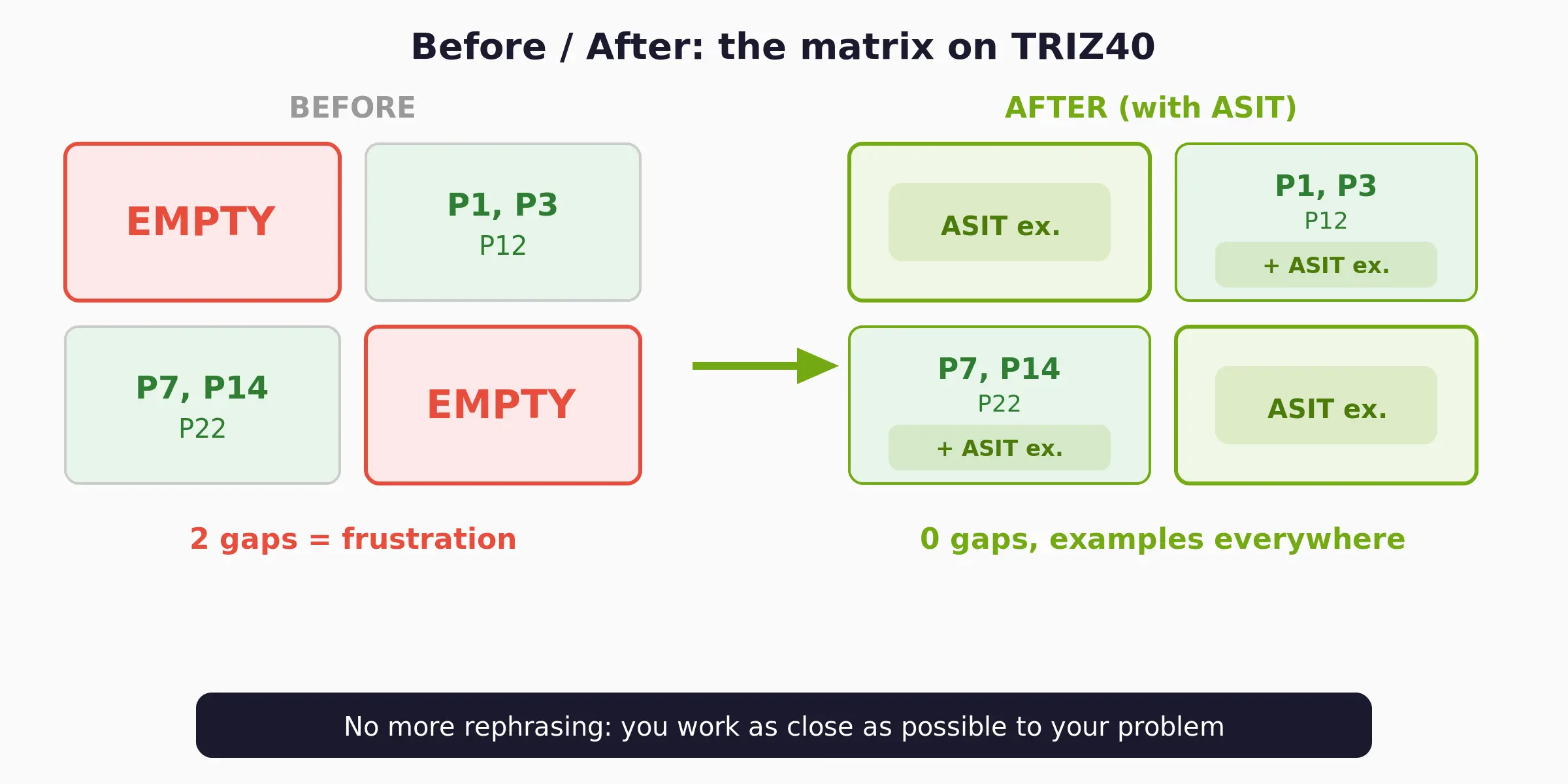
The idea is simple: every cell in the matrix, whether it contains TRIZ Principles or is empty, is now enriched with examples from ASIT. In practice:
When the matrix suggests Principles: the ASIT examples illustrate these Principles with concrete cases from various domains. You move from the abstract ("Principle 1: Segmentation") to real, actionable situations. And most importantly, you no longer need to rephrase your problem to fit the matrix: the examples covering every cell allow you to find leads directly from the contradiction you've stated, even if it's not perfectly formulated in "TRIZ language".
When the matrix is empty: the ASIT examples fill the gap. You're no longer facing a wall. The 5 ASIT tools (Unification, Multiplication, Division, Symmetry Breaking, Object Removal) generate leads where the classical matrix was silent.
Why it's more than a patch
Adding ASIT examples to the TRIZ matrix isn't just about filling gaps. It's a paradigm shift in how the tool is used. The real gain is that a matrix with no gaps and examples everywhere allows you to work as close as possible to your actual problem. No more biasing your contradiction to land on a filled cell. No more reinterpreting your problem so the tool deigns to respond. You state your contradiction, and you get leads. Full stop.
For experienced TRIZ users: the ASIT examples enrich each Principle with cases from varied domains (not just mechanics). It's an additional source of inspiration that goes beyond the historical bias of the mechanical patents on which the original matrix was built.
For beginners: instead of getting lost in the abstraction of the 40 Principles, you now have concrete, actionable examples. The path from "I have a problem" to "I have solution leads" becomes much shorter.
For ASIT users: the TRIZ matrix becomes an additional playground. The complementarity works both ways.
Often regarded as a simplification of TRIZ, ASIT turns out to be a true ally, making the matrix both easier to use and more effective. It's no longer TRIZ or ASIT. It's TRIZ with ASIT.
Try it yourself
Head over to TRIZ40.com, choose a contradiction, and explore the ASIT examples alongside the TRIZ Principles. You'll never look at an empty cell the same way again.
For TRIZ experts: how did we do it?
Rather than querying an AI when scanning the matrix, we applied TRIZ Principle #10: Prior Action (ASIT tool: Division).
First, for each of the 40 TRIZ Principles, we identified the corresponding ASIT tool and a concrete example - which was in fact the illustration chosen years ago for that Principle on TRIZ40.
Then, for each of the 1,482 off-diagonal cells in the matrix - whether or not they already suggest TRIZ Principles - we identified an ASIT proposal, citing the tool used and even the specific ASIT question that generates this type of lead. For this massive undertaking, we used an AI that we had boosted with ASIT.
This upfront preparation (not generated on-the-fly by an AI) gives the TRIZ matrix a whole new dimension: every cell becomes a concrete starting point, with a tool, a question and an example. The practitioner no longer interprets a Principle in a vacuum - they have a guided path.
Scientific references and sources
- Kosse V. (2015), Some Limitations of TRIZ Tools and Possible Ways of Improvement, Semantic Scholar
- Altshuller's Contradiction Matrix: A Critical View and Best-Practice Recommendations (2018), ResearchGate
- Ikovenko S. & Bradley J. (2004), TRIZ as a lean thinking tool
- Mann D. (2002), Hands-On Systematic Innovation
- Horowitz R., From TRIZ to ASIT, TRIZ40.com
- Jarry P., Vilar T., Jarry C., Structured Creativity: From TRIZ Principles to the ASIT Method
