
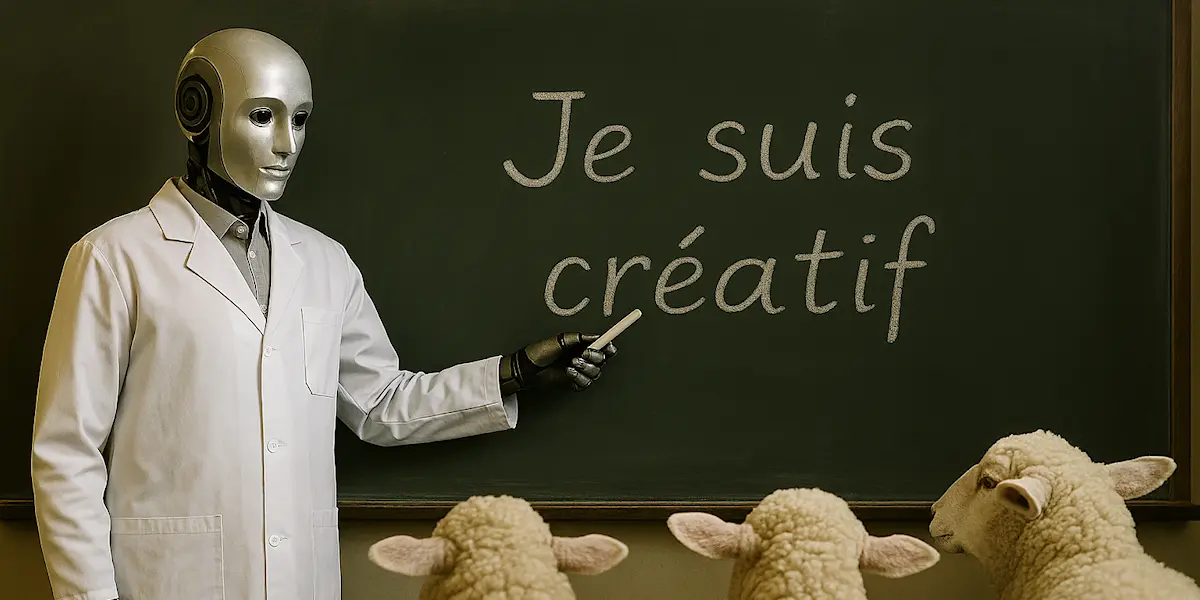
We proved that AI-generated ideas are not creative (link to our article). So why do so many companies rely on it to innovate? If that's your case, you've lost the plot.
Let's compare three protocols: brainstorming, an ASIT session, and an AI chat.

1) Brainstorming: digging random holes in a field
Ideas flow according to mood, some bounce, others don't. You sense that a different day would have produced different results. Selection happens by gut feeling, biased by the speaker's charisma or the intensity of debate. The group usually leaves with little, but convinced they chose something.
No great invention has ever been generated by a brainstorming session. Ever. (Have a counter-example? Contact me.)

2) ASIT: plowing the field
The ASIT structured creativity method doesn't try to fix causes. It searches for solutions everywhere, even where it doesn't seem logical. Constraints become opportunities. Disruptive questions posed to the right experts bring out ideas no one had considered.
Selection is equally structured: three independent axes (effectiveness, acceptability, feasibility), with precise criteria. You arrive before management with a real portfolio of options, not a wish list.

3) AI: heavy machinery for little output
AI draws from what already exists - the known, what has been written, documented, published. It cannot produce what has never been thought of.
While the cursor spins, a bias sets in: the result must be good. It's science, it's objective, it's above expert quarrels. When the answer appears, it was built to satisfy you, to match your stated criteria.
That's exactly the problem. A true innovation doesn't meet all your criteria. It surprises you by satisfying most of them in a way you hadn't anticipated. If the main criterion for a phone was battery life, you wouldn't have invented the iPhone. Not in 2007, not today.
Reception is no less biased: you evaluate ideas already filtered by AI, with the implicit seal of its validation. You don't question what the machine chose to show.
And it doesn't stop there. On the selection side, a new bias emerges. Three scenarios, all problematic:
- You already know the proposed solution: it reinforces what you already thought. Circular validation.
- You didn't know it and you like it: you adopt it without challenging it. Why would you? The machine validated it.
- You didn't know it and you don't like it: you go back to your original idea or relaunch a query. Same loop, same filter, same logic.
In all three cases, you never left what you already knew you wanted.
You have a single hole, obtained in a complex way, in a field you never plowed.
4) You must resist the false promise of AI
Too many companies jump from brainstorming to AI because they don't know ASIT.
A structured method requires a trained facilitator and real preparation. AI short-circuits all of that: fast, no need to gather experts who don't get along, with ideas stamped by the world's expertise. A golden trap.
The testimonials and documented results on our site are clear: the structured approach reduces uncertainty, unblocks projects, feeds R&D portfolios. The ROI is real.
AI excels at generating images, processing big data, debugging code. Not at producing relevant solutions in a specific context. Not at creating truly new ideas.
Don't ask it to do what it cannot do.
Discover a structured creativity method with a proven track record: ASIT.info
