

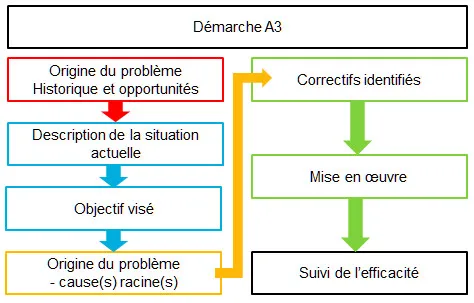
When facing a problem, the natural reflex is to find the cause and correct it. Companies formalize this approach with proven tools: Ishikawa, 5 Whys, A3 PDCA, DMAIC, QRQC, 8D.
The causal approach to problem solving
The principle is straightforward: identify the root cause, correct it, and the problem disappears. These methods are widely used in industry and form the backbone of any quality process.
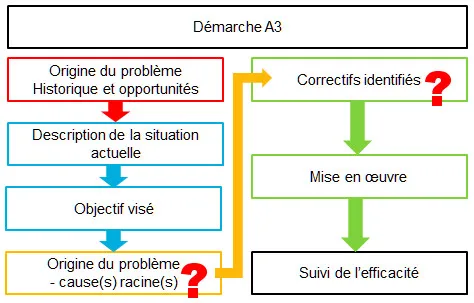
A major issue, however, is that
Two major obstacles regularly arise:
- Sometimes the root cause remains unfindable: the phenomenon is not observable, there are too many parameters, or the conditions are not reproducible.
- Sometimes the cause is identified, but no corrective action is possible: regulatory constraints, technical impossibility, or prohibitive cost.
Without an alternative method, these problems are then classified as "unsolvable" or resolved through unsatisfactory compromises.
It is worth noting that causal approaches were born during the quality-focused years (1950-1970). They excel at improving what already exists but reach their limits when facing innovation challenges.
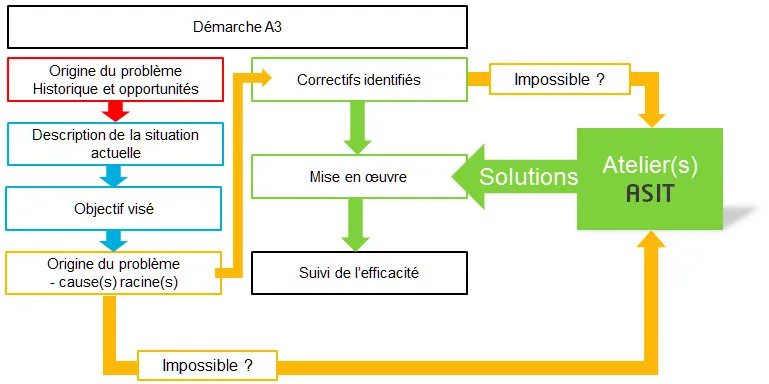
Creative resolution approach
ASIT is NOT a causal method. It does not look for the cause of the problem but prevents the problem from occurring or its effects from being harmful, even without knowing how it happens.
Example
Consider a barrier that a crowd can topple. The causal approach (5 Whys) leads to: prevent people from approaching, or reinforce the fixation. Brainstorming yields the same types of solutions.

With ASIT
The ASIT solution: use the crowd's weight to stabilize the barrier (foot plate). Here, you don't fight the cause, you use it!
Many companies now integrate ASIT into their resolution process, in dialogue with traditional causal approaches.
Check if this approach has been validated in your field: our client references.
Discover the ASIT method and our creativity training programs.
