
In 2002, the game-development company Pascal Jarry was running had just closed its doors. Twenty years of directing complex projects - Loriciels, Sony in London, Kalisto - and suddenly, time to think. The question that had haunted him for years: why does technical innovation still rely on luck and charisma in meeting rooms? He became interested in TRIZ, the Russian theory of inventive problem solving, and launched TRIZ40.com to make it accessible to a French audience.
While trying to simplify TRIZ, he stumbled upon a PhD thesis in engineering sciences: Roni Horowitz's doctorate, defended in 1999, which had re-analysed thousands of patents to extract two universal conditions and five problem-solving tools. Chills down the spine. What Pascal and his teams had experienced intuitively for twenty years had just been written down in black and white, with the rigour of a PhD. The method was called ASIT: Advanced Systematic Inventive Thinking.
The doubt before the challenge
Convinced that ASIT could help France innovate, he adapted the books into French and sent them widely: to the Minister of the Economy, to regional presidents, to R&D directors he met. Zero response. The silence was dizzying. He started wondering whether he had let himself get carried away: was the method really as powerful as he believed, or had he told himself a nice story?
The question was serious. Before transmitting, he needed a solid answer for himself. So he set himself a personal challenge, a test with no possibility of complacency: file one patent per month in a challenging domain (cycling), for a year, using nothing but ASIT. No brainstorming, no flash of genius from a seasoned engineer. Only the 5 ASIT tools and the 2 rules of the Closed World and Qualitative Change, applied with discipline.
The bet was bold. Filing a patent is no symbolic exercise: you need a new invention, industrialisable, original enough to pass the INPI filter. And you have to do it twelve times. Learning how to write a patent, it turns out, was the easy part.
12 patents in 12 months
The bet was won. Twelve patents filed in twelve months, across varied domains: bicycles, theft prevention, touch interfaces, mobile technologies, geolocation services, technical textiles. Several won awards. One patent - the i-Lock anti-theft device - became a product commercialised online.
The full list of 12 patents is public. It includes:
- i-Lock (FR WO2006108947): a theft-prevention device that locks the saddle to the bicycle while simultaneously blocking the rear wheel. Two functions in one, produced directly from the ASIT approach.
- Tub'Air (FR FR2850325): compressed air storage directly inside the bicycle frame, to re-inflate without a pump. The frame gains an additional function without any externally added element.
- Touch interfaces, context-aware mobile engines, continuous variable transmissions, data-capture methods for sponsorship tracking... seven other patents cover fields intuition would not have linked to the same engineer.
What needed to be proven was proven: ASIT is testable, the method produces measurable and patentable results, by a single practitioner, within a bounded timeframe. Not an anecdote. A protocol.
2003: the TV broadcasts
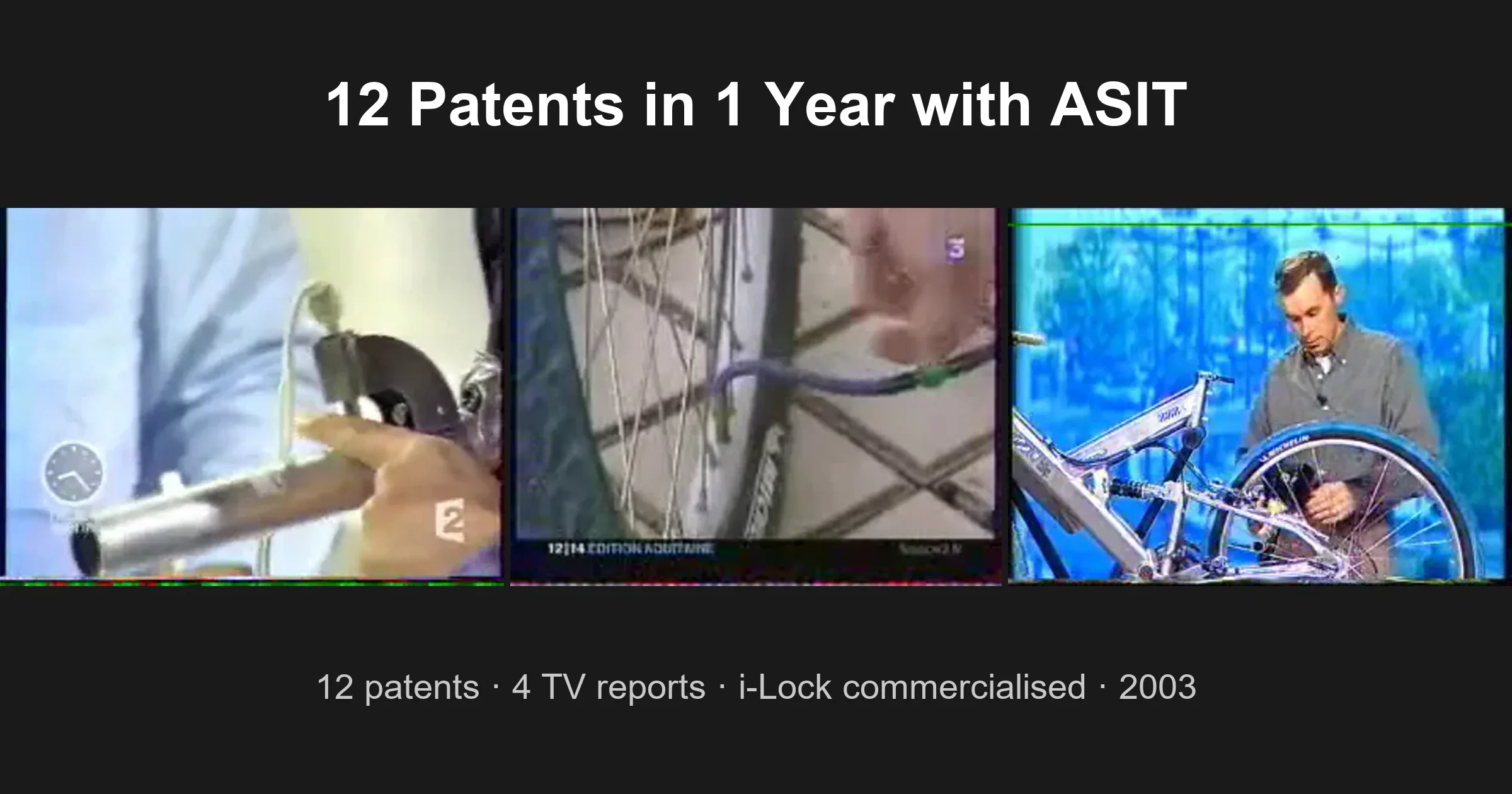
The inventions attracted media attention. In September 2003, Yann Lavoix presented i-Lock and Tub'Air on Telematin (France 2), in his "new things" segment. The same year, Guy Rechenmann devoted a feature to them in Aquitaine insolite on France 3 Aquitaine. Alain Ribet welcomed them into Ca vient de sortir, the show he hosted on TV7 Bordeaux.
These TV archives are now grouped together on the media archives section of SolidCreativity. The videos are period material, in low vintage resolution, and that's fitting: they document the spirit of 2003, a country discovering that an engineer in career transition could produce a patent per month using a structured method from an engineering PhD thesis.
What strikes you when re-watching these reports today is the tangible dimension of the inventions: no slides, no AI, no polystyrene mock-up. Products that are used, that fit in the hand, that the host manipulates. Structured creativity does not produce concepts. It produces objects.
2004: the training click
In early 2004, Pascal agreed to tell this story at a conference to an audience of industrial managers. He presented the ASIT method, explained the 12-month protocol, showed the patents, and walked through how ASIT differed from brainstorming. No call-to-action, no offer, no training page... Nothing to sell.
At the end of the conference, a queue forms at the foot of the stage: Legrand, Thales, Michelin, EADS... all of them would become clients. Their question is the same: can you train our teams? He had not expected it. He had no programme, no materials, no consulting website. ASIT training did not yet exist in France.
That's how, with no business plan or market study, SolidCreativity was born. Demand preceded supply. All that was needed was to organise it.
What the challenge proves about ASIT
Twenty years later, with hundreds of engagements at Michelin, Airbus, Renault, Legrand, Thales, ArcelorMittal, Valeo, EOS Imaging and dozens of SMEs, one could look at the 2003 challenge as an anecdote. That would miss its methodological significance.
The challenge proves three things that neither brainstorming nor generative AI can prove:
1. ASIT is reproducible. These are not 12 flashes of genius: it's a protocol applied to 12 different problems, which produces 12 times patentable ideas. The result is not due to the person, it's due to the method. That is the criterion of scientificity: repeatability.
2. ASIT produces genuinely new solutions, not recycled ones. A generative AI today could not produce i-Lock or Tub'Air - not because it lacks compute, but because it draws from what already exists. Brainstorming can't either: it converges on the familiar. ASIT forces conceptual rupture (why this is crucial) by starting from the Closed World - nothing is added to the system, things are redistributed.
3. ASIT is transmissible. The method can be taught: if Pascal could exceed his own level as an experienced engineer by using an external protocol, then other teams can do it too. That's what 20 years of field-based training confirms. A facilitator trained in 4 days runs sessions where teams file patents.
And today?
Pascal Jarry is no longer alone, nor is SolidCreativity. The client references have documented for over twenty years that the method works at industrial scale, on topics ranging from refrigerated truck bodies to barbed wire, from connected wearables to medical document management. The ASIT creativity and Hardware Agility training programmes have transmitted the protocol to thousands of practitioners.
The 2003 challenge remains, for us, an internal reference. When a prospect asks "how can we be sure ASIT isn't just another brainstorming tool in disguise?", we tell them this story, and we show them the patents and the videos. Experience precedes demonstration. Pascal proved the method to himself before selling it to anyone. He paid the price of proof personally.
That remains, to this day, our idea of pedagogy: you only transmit what you have tested yourself under constraint. Not what you have read.
Go further
The ASIT books are available on Innovez.eu (ASIT Creative Problem Solving) and Concevez.eu (ASIT Innovative Design), French adaptations by Pascal Jarry of Roni Horowitz's founding works.
To discover the method in session, the upcoming inter-company training sessions are open to R&D engineers and innovation project managers. For a bespoke intervention, contact us (ASIT topic pre-selected).
And to re-watch the 2003 TV archives, they are grouped in the ASIT patents section of the References page: the 4 TV broadcasts, with their period captions and the list of the 12 patents filed that year.
